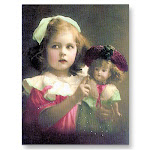
What is a Doll?

How long have we had this love affair with Dolls?

Pearls of Wisdom:

New World Dictionary describes a doll as - "a child's toy, puppet, marionette, etc. made to resemble a human being."


Friday, March 19, 2010

Papier Mache Dolls and Key Manufacturers: Muller 1805-1892

Just as man has stages he passes through over time, so do products.
John Darcy Noble describes these product “careers” in four stages:
1. Initial or “pioneer” stage - new ideas and process, exciting and vivid.
2. Successful and efficient dolls with distinct character.
3. Dolls become classics and gradually “decadence” sets in.
4. Over production cheapens quality in an effort to hold the market.

According to Christiane Grafnitz, Muller, a skilled bossierer, probably designed most of the models of his doll heads himself. He was noted to have fifty-eight different doll heads in his shop.
Muller had to get the rest of the doll parts, such as wigs and bodies, from other supplies because of the limits to his “right” as bossierer and the laws protecting other guilds and craftmen.

The dolls of the papier -mache manufacturers of the era, all have a certain familiarity. Simple wooden molds provided a basic model for the doll's head. Until about the early to mid 1800's the rest of the work was still done by hand. Each model was a creation depending on the skill of the craftman or bossierer.

The Key Manufacturers: Voit 1806-1882

Voit, was the second German manufacturer to be granted the privilege to produce and sell papier mache goods including dolls. He used wax models for the three types of doll’s heads he manufactured: The Kinderkopf or child’s head, the closed mouth Pauline or so-called French papier-mache head , and the open mouthed Pauline type head.


Child's head with modelled hair and glass eyes


Early doll by Andreas Voit featuring artistically designed human hair wig ca. 1825

Pauline type doll with human hair braids

Doll with open mouth, Pauline, with little bamboo teeth

Very early Pauline type doll around 1825

Some of the unique characteristics of Voit dolls are brush marks at the temples, open mouths with bamboo teeth, and on some dolls, flirting eyes.

The Key Manufacturers: Kestner 1805-1938

Kestner began making papier mache ladies and boys doll heads in 1815 “from his own production” as he did not have at the time, the right to make papier mache goods. He also produced his own leather doll bodies, and preferred wood or papier mache for the arms. His dolls were simply modeled and not marked.

Museum of Sonnenberg; Catalogue of Johann Daniel Kestner 1840

Pages from an early Kestner's manufacturer's catalogue illustrating
doll's heads and hairstyles.


In 1899 the first trade mark was registered, a circle with a doll in the middle, flanked on either side by two shoulder heads.
In 1896 the trademark JDK and the crown was registered. The company closed down on 1938.


The popularity of the papier mache doll extended over 70 years from the papier mache dolls of the early 19th Century produced in Germany by Mueller, Voit and Kestner,to the American versions in the later part of the 19th Century produced by Greiner.*
The style of the dolls reflected the changing taste of the times.
*Greiner Dolls will be featured on a later post.

From the Forests of Thuringia

From the time of Francis 1 of France (ca.1540) doll makers always used a mixture of clay, paper and plaster. By the 18th century German communities had master the art, and became important manufacturers of toys alongside the towns of France. Particularly noted were the communities of Sonnenberg, and Nuremberg, which developed from insignificant country towns. In Nuremberg alone there were seventeen workshops devoted to toy-making
(King, p. 56).


Dolls with typical clothes ca. 1800 and 1820


Nuremberg has more than 600 years of tradition as a city of toys. Production of and trade in toys are an integral part of the city’s general industrial history, but they are also an important part of Europe’s cultural history of toys because of their economic and cultural influence. This history spans from the beginnings of recorded doll production in Nuremberg towards the end of the 14th century, to the ever more sophisticated craft of toy production in the pre-industrial age, and right up to the industrial mass production of metal toys in 19th and 20th century.
Part of the reason for their prominence was their location.
Most were located near the large forests of Thuringia which provided the raw materials for toys,
as well as their access to local paper mills.


In a short time these communities became major trade centers, and travelling merchants would sell German toys in fairs all over Europe, thus asserting their position as the metropolis of toys and dolls throughout the world.

What is Papier-Mache?

According to the Merriam-Webster Online Dictionary, Papier Mache is a French term meaning "literally, chewed paper; a light strong molding material of wastepaper pulped with glue and other additives." This substance can be placed in molds to create doll heads.

Childlike doll Biedermeier period 1830-35
From the earliest creation of papier mache dolls, the masse was pressed into a wooden mold. While the molds made the basic shape of the dolls, it was the skill of the bossiere or presser who created the unique doll. Additives to the papier mache made each maker’s recipe unique. These might include linseed oil, varnish, chalk, ground sand, potters clay, resin and soot .
One account states that when released from the molds the papier mache heads were smoothed, the two halves joined with glue and then the whole was painted with a mixture of lime wash and ground colours and allowed to dry. The eyes, lips and hair were then painted and a coat of varnish applied.
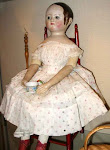
The papier mache heads faithfully reproduced the curls of the current hairstyles, and the finer specimens had coiffed wigs made of mohair or real hair. They had sweeter faces and were more pleasant to handle than the older woodens.
The bodies were always stiff, shoes painted and the wooden arms and legs attached to a stuffed torso made of kid or cloth.

Monday, March 15, 2010

The Napoleon Influence

Napoleon and Josephine

Napoleon Bonaparte of France rose from obscurity as an artillery officer to ultimately crown himself Emperor in 1804. He spread himself from Spain to Egypt to Russia, but was eventually defeated by the combined might of England, Russia, Prussia, and Austria.At last, Napoleon abdicated, only to escape his confinement at Elba to begin his One Hundred Days, gathering French forces as he marched back to France. At Waterloo, Wellington was victorious. Despite his misgivings, Napoleon's power was broken for good.


Born Marie Rose Josephine Tascher de la Pagerie, Josephine became a noted Parisian socialite after marrying Alexandre de Beauharnais.

Marie Pauline...Princess Borghese sister of Napoleon Bonaparte


She survived both the execution of her husband, and imprisonment during the French Revolution to marry Napoleon Bonaparte, a promising general whose rise soon made her Empress of France.

Greco Roman Influence


She was popular as Empress, being kind, gracious, gentle and generous. However, Napoleon soon grew frustrated that she did not present him with an heir.


Divorce was inevitable, but it still came as a shock to her when Napoleon wanted to end the marriage to pursue a dynastic link with Marie Louise of Austria.


She died in 1814, but remained a loyal friend to Napoleon right to the very end. She was even popular and respected by Tsar Alexander and the supporters of Louis XVIII after the Emperor's first abdication.


From the Empire to the Bierdermeir Period 1800-1820

Bonaparte did not ignore men's rôle in the revival of the textile economy and he enforced male military officials to wear white satin breeches on formal occasions.


Napoleon Bonaparte was keen to make France a leader of fashion and innovator of design and craft skills. He was following a long tradition of promoting the French economy through fashion.


The Empire Dress
Following the French and American revolutions, there was a drastic shift in fashion for both men and women, though for women this change would be short lived. Classical Greek and Roman images were evoked during this period. A classical inspired silhouette was adopted by women, marked by a long, narrow, uncorsetted, and high-waisted design.


The reemergence of Greek and Roman themes influenced dress and hairstyle as well. Dress was simple light colored chemise of muslin or calico with a stole for warmth.


Replacing the Rococo period’s plaits and powdered wigs, were short curly hairstyles with curls combed forward on the face,
also a braid wound at the top of the head with curls painted to the side was also popular.


Shoes were flat heeled or sandals. By 1805 warmer materials such as taffeta, silk or velvet were used. Lace was added at necklines and hemlines. Hats were turbans with feathers, flat straw or tulle caps.
Empress Josephine was a great fashion leader. She was an ideal model for the slender fashions of the day. Ladies dresses had extra fabric gathered into the back and trains were seen again for evening.

Monday, March 8, 2010

“Marie Antoinette and Louis-Auguste” a Fairy Tale Without a Happy Ending

Children as we know them today, spend a golden decade in a special wonderland before becoming teenagers. Not so children of earlier decades, there was no such wonderland. Even for little aristocrats.


Infant Marie Antoinette


Marie Antoinette and siblings


The young Habsburg archduchess (born on November 2, 1755) was a beautiful girl who loved music and dancing.


Young girls were expected to make good marriages, and twelve years of age was not uncommon for a wedding ceremony. A lady had to acquire many accomplishments during her early years
to manage her future home.

A meaningful political alliance, not a love match, was most important to the Empress as she determined the future of her youngest girl.


Marie Antoinette the Last Dauphine of France


At fifteen - Marie Antoinette ( or Madame Antoine,) as she was known in her native Vienna,
left her Austrian home to solidify their alliance with France, (previously longstanding enemies). Within four years, the young foreigner would become queen of France.

Had the Empress lived to learn her child’s fate, she would surely have regretted her political-marriage decision.

Dauphin Louis-Auguste
Once babyhood was over, boys were breeched, and along with breeches came swords, which they were taught to use.


The Dauphin
The young gentleman had many people depending on him, and many duties to assume...There was much to be learned in order to defend his property.


Adieu, my dear daughter; a great distance is going to separate us, but be just, be humane and imbued with a sense of the duties of your rank and I will always be proud of the regrets which I shall always feel ... Do so much good to the people of France that they will be able to say that I have sent them an angel.