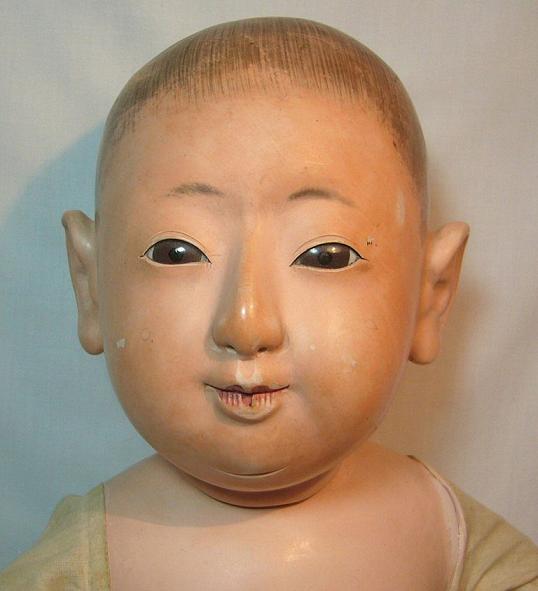
They were crafted from materials available to the area. The Japanese archipelago was rich in such woods as cypress, nutmeg, sandalwood, etc. Initially wood or cloth were used for the construction of dolls, also Papier mache appeared as early as the 17th century.
But a very fine composition losely resembling porcelain, was given to many dolls as a pigment, and as a covering with a lustruous sheen; This was known as gofum, and consisted of crushed oyster shells, animal based glue and water, the light quality of the medium allows the molding of such fine detailing, resulting in the realistic expressions unique of the Japanese doll.
The main differences on these dolls, besides their outward appearance and facial features; is that European dolls, are classified based upon the material used in manufacturing,.eg: papier-mâché, china, bisque. Japanese dolls are classified upon what the doll represents, as they were all similarly constructed from Gofun covered papier mache or wood.
Textiles supported the structure of the dolls as well as for clothing. Stiff brocade fabric often supported the body, while silk covered the wood structure as well as the joints for those dolls with joints. Preferred textiles for the clothing was silk and silk weaves, such as, satin, gauze,velvet etc. However, Japanese culture was very structured. Much as specific plaids were used for specific clans in Scotland, particular types and weaves of cloth were reserved for specific classes. Because of this, the Japanese ruling classes limited what colors or textiles could be used by various groups in society.

The principal types of Japanese dolls are : Hina, Gosho, Musha, and Isho.
Hina:
The Japanese Doll Festival , Hina-matsuri, or Girls' Day, is held on March 3. Platforms covered with a red carpet are used to display a set of ornamental dolls hina-ningyō representing the Emperor, Empress, attendants, and musicians in traditional court dress.

Emperor and Empress form the top platform of a Hina doll display.
(file from Wikimedia Commons author… Nesnad.)

This is a Hina doll set photographed at a Japan Festival in Kansas City.
(author: Michaelbuddy copy from en.wikipedia)
Formerly, people believed the dolls possessed the power to contain bad spirits The origin is traced to an ancient Japanese custom called hina-nagashi ( "doll floating"), in which straw hina dolls are set afloat on a boat and sent down a river to the sea, supposedly taking troubles or bad spirits with them.

Traditional Paper dolls For Girl's Day display.
(Courtesy of Alan Pate)
The Shimogamo Shrine in Kyoto celebrates the Nagashibina by floating these dolls in the river to pray for the safety of children. People have stopped doing this now because of fishermen catching the dolls in their nets. They now send them out to sea, and when the spectators are gone they take the boats out of the water and bring them back to the temple and burn them.
Families generally start to display the dolls in February,
and take them down immediately afterthe festival.
Superstition says that leaving the dolls past March 4 will result in a late marriage for the daughter.

Gwen John (1876 - 1939)
National Museum, Cardiff circa 1927
Painting depicts the interior of the artist's studio in rue Terre Neuve, Meudon, Paris. The doll, dressed in a red and blue kimono-style garment, is seated against an open box in the centre of a table top. Still-lifes situated in simple interiors such as this are central to the artist's later oeuvre. This painting is one of two known versions of the composition.
Gosho Nyngio:
Term gosho literally means "palace," and it is amidst the imperial court of 18th-century Japan that we must first look to find their origin.

Gosho Nyngios are my favorite, and you can see why these chubby dolls are so irresistible.


These examples Gosho Nyngio are courtesy of Alan Scott Pate
During the Edo period (1615-1868), it was part of official protocol for military lords (daimyo) to pay respect to the emperor in Kyoto, bringing with them an impressive array of gifts. An itemized list of this tribute (mokuroku) was presented to the emperor, and, in acknowledgment, a doll was given to these powerful military lords. By the mid 1700's this type of doll became somewhat codified, typically depicting a corpulent male child of three years of age, either naked or with a small haragake
bib, frequently holding an auspicious object conveying wishes for health, longevity, prosperity, martial success, or enhanced fertility These dolls are now generally referred to as gosho-ningyô or palace dolls. from Alan Pate "Antique Japanese Dolls"
Musha Nyngio:
The Japanese samurai, wielding a curved edge sword, executing astonishing feats of endurance and agility, has captured the Western imagination since Japan first opened its doors to the West in the mid 1800’s.
 Musha Ningyô or warrior doll are very popular among Western collectors. Embodying the martial spirit of the samurai, these figures are decked out in full military regalia with lacquered armor, swords, arrows, bows, and other assorted weapons. They frequently represent very specific historical characters and are a fascinating window into Japan’s rich military past
. ( from Alan Scott Pate )
 Fish-shaped banners flying outside of people's houses, it would mean it is getting close to the May 5th festival. Families with sons all over Japan traditionally wish for the boys' health and prosperity by hoisting carp-shaped windsocks outside. This fish, the carp, is said to swim upstream, and its heroic persistence makes it a traditional symbol and ideal for a boy. The celebrations may also include setting out warrior dolls, representing legendary Japanese heroes, and warlike ornaments inside the houses; 200 years ago the display might have been of real weapons and visible from the street.
(Excerpt from Judy Shoaf "Boy's Day Dolls, Musha -Nyngio")
Fashion Dolls

"Japanese Doll with Fan"... painting by Dan Beck
Isho Ningyo:
The "fashion doll" or ishô-ningyô is perhaps the most diverse and layered of the many categories of Japanese dolls.
 Originally depicting beautiful women (bijin-ningyô) and popular actors, they emerged in the latter part of the 17th century in Kyoto. Celebrated for their spectacular costuming, this form evolved to encompass many other types including the hyper-realistic iki-ningyô (living doll), talismanic dolls known as hôsô-ningyô, and a myriad of other figures depicting nearly every facet of Japanese society.
 (Alan Pate Antique Japanese Dolls )

French ca.1930's "Fish" (unknown)
Wooden Kokeshi :
Are dolls that have no arms or legs, but a large head and cylindrical body, representing little girls or/and boys.

Kokeshi Doll from my own collection.
Dating back to the early 19th century and originally from northern Japan. They may have had a spiritual significance representing a wish for a healthy child. They are handmade from wood, have a simple trunk and an enlarged head with a few thin, painted lines to define the face. The body has a floral design painted in red, black, and sometimes yellow, and covered with a layer of wax. The bottom is marked with the signature of the artist.
Courtesans

Mitsuore Oiran Courtesan, Edo Period 19th Century, 15" tall.
Hannig Collection...(From Alan Scott Pate, "Early Japanese Play Dolls)
Geisha:
The meaning of the word in English is “artist” or “performing artist”. These beautiful women are traditional entertainers who perform various Japanese arts such as classical music and dance. A Maiko (or apprentice Geisha) wears the white make up and traditional Kimonos that we identify with the Geisha (“maiko” means “dance child”), and they are usually very young, 18 or younger. A geisha does not have to start out as a maiko, if she has the opportunity to enter the community as a full geisha. However, those who do go through the maiko stage can enjoy more prestige later in their professional lives.

Isho Ningyô depicting an Oiran courtesan Edo Period, 18th Century, 15" tall
Hannig Collection (From Alan Scott Pate, "Early Japanese Play Dolls")

Movie poster for 1953 Japanese movie A Geisha, Gion Bayash.ca. 1953.
Metropolitan Museum of Art

Geisha with samisen Sakura Dolls of Japan (Abston & Uchioke, 1963).
Courtesy of Judy Shoaf.

Tokyo Geisha with Shamisen ca. 1870s
"Strange, exotic dolls amongst the treasures of the expedition"

When In 1853-56, United States naval office Commodore Matthew Perry led a U.S. naval expedition to force Japan to begin trading with America–and the rest of the world, one of the items he brought back was a pair of Japanese Ichimatsu dolls.

Rare Ichimatsu boy courtesy of Alan Pate
Ichimatsu-ningyô :
Is what the Western world conceives as a Japanese play doll and they were given to little Japanese girls to hug. Originally this was an actor’s doll , even its name was a popular actor’s name. These dolls were sometimes given to newlyweds as gifts to procure for a healthy child.

From my collection: Ichimatsu boy, Motchmann type.
Notice the wonderful detail on his face, heavily molded lips and exotic almond eyes.

Same boy from my collection: Notice the Motchmann type body.
He is made from papier mache and cloth, there is a voice box mechanism in his torso that works.
A wonderful wardrobe is been made especially for him by my dear friend Joan Malone.
"I had an opportunity to see these two (survivors of a group of 13) dolls brought back by Commodore Perry, as part of a special visit to the Smithsonian storage complex arranged during the 1999 J.A.D.E. Convention. They are about 10" tall and are in poor condition, but the gofun lacquer is still beautiful. They are illustrated in Artifacts of Diplomacy by Chang-Su Houchins, Smithsonian contributions to Anthropology 37 (1995), p. 129; the description on p. 128 clarifies that they were part of a group of dolls given to the expedition by Izawa Mimasaka-no-kami in 1854; the dolls were noted as "naked dolls" in the Japanese records" (Courtesy of Judy Shoaf )

Motchmann -type doll made in Germany.
Notice the "floating hands and feet" allowing turning at the wrist and ankles.
These dolls were modelled after the Ichimatsu dolls brought by Perry.

Western girl with collective dolls.. notice the Ichimatsu held foremost in her arms.
Courtesy of Judy Shoaf
Already, however, at about the same time as Perry's expeditions, at least one Japanese play doll had found its way to Germany, perhaps through a Dutch trader. A German exporter from Sonneberg saw such a doll-- --and commissioned a sculptor to create the prototype of a European doll based on this Japanese doll. The result was a style of doll called the "Motschmann-type" or Taufling doll. We can infer that the Japanese model was a flesh-colored baby with glass eyes, cloth joints, and a device in the belly to produce a "ma-ma" sound when squeezed. It would have been a much poorer quality than the elegant dolls brought back by Commander Perry, but it introduced into the Western doll world some new ideas. Excerpt from Judy Shoaf “How Japanese Dolls came to Europe and America”

Picture from an 1874 French book of a child with an Ichimatsu.
(Courtesy of Judy Shoaf.)

Little Girl with a Japanese Doll
Artist: Cassatt, Mary Stevenson (American 1845-1926) Impressionist Painter

In a contemporary lithograph a little girl of the late 1890’s wanders through a toy store.
The picture is full of information but we notice particularly that the Oriental doll is now an authentic Japanese import, and that real Japanese lanterns decorate the store.
( From Kit Robbins collection)

These probably date from 1890-1910. (grp of dolls Ichimatsus ) Judy Shoaf's collection.

John Haberle ca. 1891
"Starting in the 1870s, the Japanese themselves exported many of their own ichimatsu dolls to America and Europe. Judging from the materials, the European market was more likely to get deluxe dolls, while a cheaper type of doll, but still very charming, was common in the US. familiar enough to be introduced in advertising and magazine illustration, comic postcards, children's books, and so on." Excerpt from Judy Shoaf's site.

From my collection Ichimatsu boy doll lovingly dressed by Joan Malone,
and Ichimatsu girl with gorgeous face and original silk kimono.

Ichimatsu boy and girl,
With friend "Patsy" decked out as a Chinese girl, and steiff bull dog.
From my collection.

"The Friendship Doll" courtesy of Alan Scott Pate.
In 1927, 58 Ichimatsu dolls were sent to the US from Japan as a gift of friendship. Before and during World War II, most of these Japanese Friendship Dolls were stored away so as not to offend Americans that did not want to be reminded of a country that was the enemy.
Consequently, time, and neglect has taken its toll on these treasures,and others have been misplaced. However there is an effort to locate each of the special 1927 Envoy Dolls (12 are still missing) and to insure that each of the surviving dolls is properly identified and cared for.
 "Sayonara"
I would like to thank the following sources:
Judy Shoaf , for so generously letting me use excerpts and pictures and photos from her wonderful website: How Japanese Dolls came to Europe and America: A "Prehistory" of Japanese Dolls in the West.
My deepest thanks to Alan Scott Pate, for allowing me to use the beautiful pictures from his site "Antique Japanese Dolls "depicting dolls from the EDO period, as well as very important data from the time frame and history of these dolls. Author of the two most authoritative works in English on antique Japanese dolls, (Ningyô: The Art of the Japanese Doll, Tuttle, 2005 and Japanese Dolls: The Fascinating World of Ningyô, Tuttle, 2008).
Thanks to "Antique Japanes Boy Textiles" http://www.kimonoboy.com





.jpg)