
What is a Doll?

How long have we had this love affair with Dolls?

Pearls of Wisdom:

New World Dictionary describes a doll as - "a child's toy, puppet, marionette, etc. made to resemble a human being."


Tuesday, July 13, 2010

Pale yet lovely, glazed and beautiful.

The most beautiful china head dolls unquestionable belong to those with modelled hair,
historically produced during the late period of 1830’s until the early part of the 20th century. Among these, the lady- like china stand out as art objects rather than toy dolls.
The highest number of production made in Germany from 1850’s through 1890’s, centered around the cities of Sonnenberg and Nuremberg.


Ribbon winners chinas

The Hair Dress is a good indication of the period the dolls were manufactured, as they imitated the styles that were fashionable at the time they were made…For example a doll with a chignon, or waterfall hair dress, could be dated as 1860-1870. Bangs would indicate a much later period, early 1890, when this style was worn.

With this in mind, I will attempt on forthcoming posts to show samples and describe types of China Heads according to the decades they were made, in the hopes to achieve an easier, interesting introduction to these dolls while doing justice to this vast industry… and, more importantly, to their fragile beauty.

Alt, Beck and Gottachalck (ABG) Cafe Au Lait "Spilled Curl" hairstyle ca.1860


China head dolls wearing the typical hairstyles of the 1860-1890 periods: Curly Top, Civil War and Flat Top

Civil War type china head ca. 1860

Conta-Boehm "Waterfall" hairstyle ca. 1865


"Countess Dagmar" Parian shoulder head

Quite often Chinas were cast on the same molds as Parians, so its not uncommon to find both glazed Chinas and Parians with the same type heads, as an example the so-called
“Countess Dagmar”.


"Countess Dagmar" china shoulder head using same mold as above


"Two Sisters" Lego Museum


Blonde "Low-Brow" style ca. 1880-1890 possibly Hertwig


The number and variety of face type and hair dress indicate the possibility that a great majority were manufactured in small back yard kilns, a family industry, as toy making had largely been in Germany. Their beauty and detail largely depending on the skill of the individual workman.


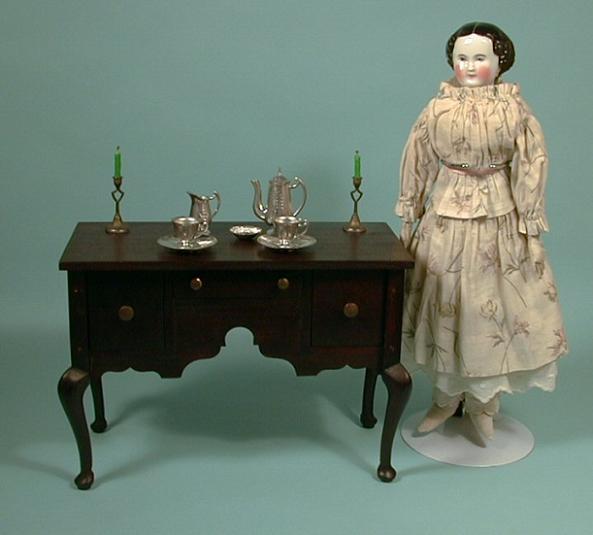
China head doll ca. 1840; Parian Bisque shoulder head doll ca.1860; French Tea Set ca. 1850


Two china dolls of very different character, each with inset glass eyes (McDonald Archive, Museum of the City of New York)


"Frozen Charlottes" of various size, including a tiny Frozen Charlie.
These adorable tiny dolls will be discussed at a later time.


Beautiful "Civil War" type bride doll ca. 1860


Queen Victoria by Sir Edwin Landseer ca. 1839


Many china heads, especially those with unusual hair styles, are called "portrait dolls" and are named for those they are supposed to resemble-Queen Victoria, Mary Todd Lincoln, Dolly Madison, Countess Dagmar, Jenny Lind, Adelina Patti, and Alice in Wonderland. It is unlikely that these ever were actual portraits. Doubtless some fancied resemblance has caused collectors to so name them….The dolls from this category will be discussed separately.


"Queen Victoria" Kister, ca. 1840

Unfortunately, most china dolls are unmarked that makes it difficult to distinguish which company designed which doll. Sporadically, dolls are marked within its shoulder plates, putting the company name that manufactured the item. Some companies also put a number on the reverse part of the shoulder plate of the china doll.


Shoulder Head shards probably excavated at sites of destroyed doll factories in Thuringia
Germany ca. late 1800's


Similar "Civil War" hairstyle and outfits on china head and on little girl ca. 1860-70


Grouping of German china dolls, ca. 1840-1860


China heads made after 1898, will of, course be marked GERMANY, Occasionally they will be marked with letters or numbers, but there seems to be no way of finding out what these markings mean.


Harper's Bazaar referred to china dolls as "old fashioned" in 1873, though they continued being made well into the early 20th century. China doll heads were produced in large quantities, in different parts of Europe, counting in the millions.


"Flat Top" hairstyle on China head wearing beautiful French fashion dress.

China Shoulder Head dolls ca. 1880


Quite often one can find these charming dolls sitting or standing alone in antique shops and even in flea markets, waiting to be loved and valued again. We need to appreciate these old dolls with particular affection, even if for the thought alone that they have survived well over a hundred years.

Tuesday, July 6, 2010

"Waifs and Strays" The Poor Victorians


The nineteenth century saw a huge growth in the population of Great Britain.
The reason for this increase is not altogether clear. Various ideas have been put forward; larger families; immigration, especially large numbers of immigrants coming from Ireland fleeing the potato famine .
By the end of the century there were three times more people living in Great Britain than at the beginning.
Therefore all these factors – population explosion, immigration both foreign and domestic – added up and resulted in a scramble for any job available. If work dried up and men were laid off, they had no savings to fall back on.


Victorian society did not recognize that there was a lower class.
'The Poor' were invisible. Those members of England who worked as chimney sweeps, rat catchers, or spent their days in factories had no place in the echelon of the upper class, although their services would be needed from time to time.
Etiquette played little part in the poor's daily existence. But that's not to say that pride wasn't available. There was a 'social stigma' to applying for aid, and some families preferred to keep to themselves and figure out their own methods of survival.

George Elgar Hicks, The Sinews of Old England (1857)

This picture also expresses the ideal image of womanhood, although it depicts a lower-class family. It is obvious that this woman looking up at her husband in rapt admiration completely relies on his manly powers as the financial and mental supporter of the family. The simple, but clean and comfortable interior of their house and the neatly dressed child suggest that the woman is perfect enough to keep their house properly both as a wife and as a mother.


In Victorian England, a great stratification existed between the upper and lower classes. The upper classes claimed that the lower classes "cannot be associated in any regular way with industrial or family life," and that their "ultimate standard of life is almost savage, both in its simplicity and in its excesses." (Reader, Victorian England, 117-119, 1973)
A lack of adequate nutrition, medicinal care, and sanitary resources also contributed to the stigma attached to poor people. The disease and malnutrition that ran rampant among the poor caused 'stunted physiques" and pale countenances that caused not only economic division between the classes, but also physical division as well.


Tess of the D’Urbervilles

A ne'er-do-well exploits his gentle daughter's beauty for social advancement in this masterpiece of tragic fiction. Hardy's 1891 novel defied convention to focus on the rural lower class for a frank treatment of sexuality and religion. Then and now, his sympathetic portrait of a victim of Victorian hypocrisy offers compelling reading.


In the 19th century, children of the poor lived in very difficult circumstances, near factories and in unhealthy flats with no hygiene. The houses or tenements were cramped and a simple cold could often lead to death. Sanitation didn't exist until around 1900's. These conditions favoured infant mortality; and diseases like cholera flourished when they drank tainted water. The rate of mortality was high. There were no vaccines available in the 19th century.


Home made wooden peg doll with crude handcarving


"Boys Sold as Sweeps"


"Poor Girl"

"A 19th century London Alley"


"The Patient" ca. 1871


'Please, sir, I want some more.'


"Small Frozen Charlottes in Tin" poor child's dolls


Nine-year-old Oliver is a resident in the parish workhouse where the boys are "issued three meals of thin gruel a day, with an onion twice a week, and half a roll on Sundays." The workhouse is run by Bumble the Beadle, Limbkins is Chairman of the Board of Guardians for the workhouse.


Children of the poorer families would probably have worn second hand clothes that were often patched to make them last longer.


Lower Class Children Playthings

"Homemade Peg doll"

If they were lucky they might have had dolls made from rags, tin soldiers, wooden toys carved by family members.


Working Class Children

"Frozen Charlotte" All Bisque Victorian Penny Dolls


"Little Seamstress"

" Peg Dolls"

Nikolai Koshelev "Children Rolling Easter Eggs" ca.1855

They played outside games when they had time that would cost very little - a hoop to run down the street with, hopscotch or maybe a game of marbles made from clay. You could make dibs from clay which would be shaped then be heated in the oven to make them hard.


"Playing Hopscotch"
A small black board and chalk would have been quite a luxury. A game of hopscotch just required a piece of slate and a small piece of chalk to mark out the numbers on the pavement.

Child Labour

Children were expected to help towards the family budget.
Charles Dickens' Victorian Children

Child Working in a Brickyard

They often worked long hours in dangerous jobs and in difficult situations for a very little wage. At an early age the children would be out looking for work or roaming the streets looking for odd jobs. Some would be stealing for food.

Street Urchins Playing


Pickpockets were in abundance and even a stolen handkerchief or scarf could be sold for food.

"You've Got to Pick a Pocket or Two"

John Everett Millais "Cinderella"


"Lucky Chimney Sweep"

There were the climbing boys employed by the chimney sweeps.


Little children were hired to scramble under machinery to retrieve cotton bobbins; boys and girls working down the coal mines, crawling through tunnels too narrow and low to take an adult.

"Little Match Girl"


Little Waif with Wheelbarrow


Some children worked as errand boys, crossing sweepers, shoe blacks, and they sold matches, flowers and other cheap goods.


The best way for society to deal with the poor was to ignore them. They were 'burdens on the public'.
Although Poor Laws were put into place, it wasn't until after the Victorian age ended that 'the lower class' was able, through education, technology, and reform, to raise itself( in some cases literally,) out of the gutter.
Victorian society could be quite pleasant, but only depending on your financial status.
From an Article by "Tudor Rose"

By Edwardian times, old attitudes about the 'deserving poor' were beginning to change. The work of organizations like the Waifs and Strays' Society alerted people to the problems of destitute children, whose poverty was through no fault of their own.