

.jpg)




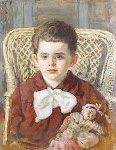


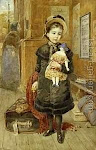




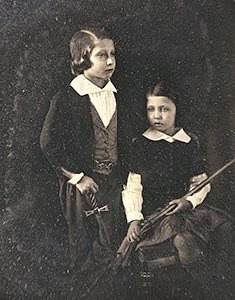
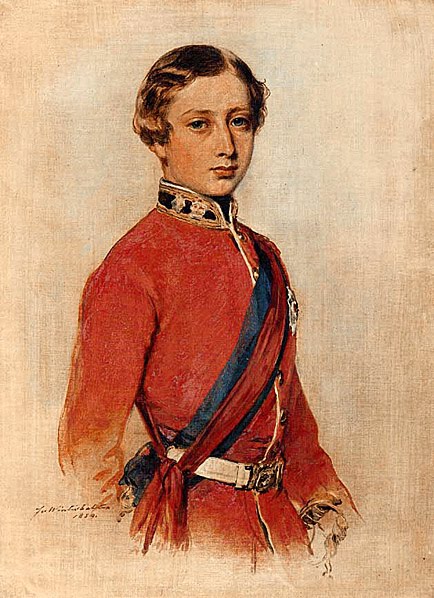
Boys growing up during the Victorian and Edwardian period generally wore what was selected by their mothers. They generally had little say in the matter. But that is not to say they did not have opinions of their own. It is probably safe to say that of all the common styles, the Little Lord Fauntleroy suits, (especially those with elaborate lace collared blouses,) and kilts were among the most disliked by the boys that had to wear them. Only limited information is available on boyish preferences. As a result, it is unclear which were more disliked. Available information suggests, however, that Fauntleroy suits and kilts were some of the most disliked by the boys dressed in them. Many a youngster secretly hated the author of the book for creating the vogue compelling him to wearing lace collars and black velvet suits.
 "Mary Pickford" as Little Lord Fauntleroy
 Frances Hodgson Burnett, (November 24, 1849 - October 29, 1924) was an English-American playwright and author. She is best known for her children's stories, in particular "The Secret Garden", "A Little Princess", and "Little Lord Fauntleroy".

 Francis Hodgson Burnett helped popularize a style of dress for boys that proved exceedingly popular among doting mothers in the late 19th and early 20th century. Little Lord Fauntleroy is the first children's novel written by this author; her famous fictional creation was modeled after her own son, Vivian, and thereby condemned a generation of "manly little chaps" to the picturesque romantic outfits. The actual descriptions of Little Lord Fauntleroy suits were limited in her book. Perhaps even more influential than the text were the pictures drawn by Reginald Birch, the artist who illustrated the story. The book and illustrations were responsible for an enduring vogue of boy's clothes in the style of the Cavalier or Van Dyck Period worn by the young hero of the story.
 "What the Earl saw was a graceful, childish figure in a black velvet suit, with a lace collar, and with lovelocks waving about the handsome, manly little face, whose eyes met his with a look of innocent good-fellowship."
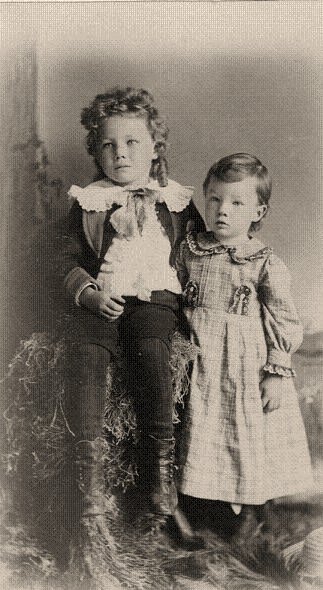 Little Lord Fauntleroy and his sister! What a outfit that little boy has on -- all ruffles and bows and those curly locks (in sharp contrast his sister is wearing a rather austere homemade frock!) This Carte de Vista studio shot was taken around the turn of the century, over 100 years ago at the Merrill studio in Lexington, Illinois.
  A charming period photograph of a young couple and their two dashing little cavaliers.
 Fancy velvet suits for boys were not the creation of Mrs. Burnett. She was born in England and lived for a time in France. Thus she got many of her ideas from European fashions that were worn by boys from affluent families. The clothing styles popularized in her book were based on the styles she adopted for her two sons. She made the boys' clothing herself. It became a labor of love, enhanced by the young author's romantic imagination. The result was the flamboyant page-boy costume popularized in her book and accompanying illustrations. The drawings pictured a knee pants velvet suit and deep lace collars red or black satin sash, long hair, and a picturesque plumed hat.
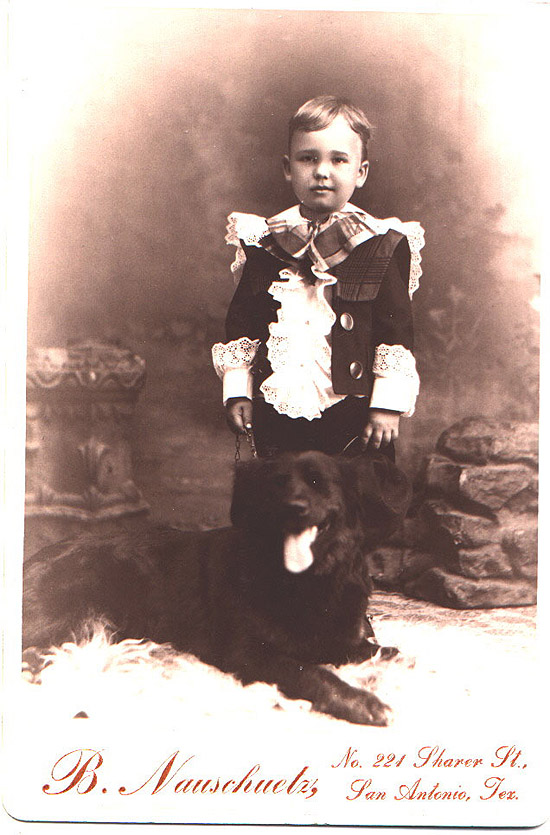
 Here is a wonderful photograph of a boy about six years old, dressed in a frilly Little Lord Fauntleroy style, with his trusted dog at his side. The image is dated July 1899 on the back. I’m sure his mother loved this photo, but one has to wonder what he thought of it years later, when he had a different image to uphold.
 Evan Martin’s suit, ca. 1900
Evan Lewis Martin was the son of Henry and Bette Hannah Martin of Pea Ridge (Benton County). He died at the age of 12 in 1910. In his death notice, the Rogers Democrat reported that Evan "loved music and was a fine singer for a child.”
Evan's linen suit with its ruffled collar is a variation of the Little Lord Fauntleroy suit, a popular style of the late 1800s and early 1900s. Based on the clothing of the main character in the book Little Lord Fauntleroy (1886).
 Only a minority of boys wore ringlet curls with these suits, but the photographic record confirms that many boys did.
 " Edwardian Family" by Georgina
The Fauntleroy rage began in the 1880s and was wide spread during the 1990s. The popularity of the classic Fauntleroy suit continued through the turn of the century. Many boys who did not wear the actual style suit, wore suits with Fauntleroy elements such as a fancy blouse or floppy bow.

 It was most popular for boys about 3–8 years of age, but some older boys wore them as well. Boys, as old as 13 in rich or aristocratic families; are known to have worn them. The heir to the Johnson & Johnson fortune, for example, was still wearing velvet suits at 13. It has been speculated that the popularity of the style encouraged many mothers to breech their boys earlier than before and was a factor in the decline of the fashion of dressing small boys in dresses and other skirted garments.
 Papier Mache boy with glass eyes, ca. early 19th century; newer clothes, dressed in the Edwardian style. Houndstooth print wool jacket and pants decorated with braiding and soutache, lace blouse with satin ribbon, leather bootines not shown. This doll is from my collection.
 Doll House figures by "Georgina"
_01.jpg) Freddie Bartholomew "Little Lord Fauntleroy"
Freddie Bartholomew "Little Lord Fauntleroy" Freedie Bartholomew and Mickey Rooney ca. 1936
14" German bisque character, 7603 by Gebruder Heubach, appealing pouty expression.. Solid domed bisque socket head, blonde painted boyish hair, intaglio dark blue eyes, closed mouth, downcast lips, Sonneberg composition and wooden fully-jointed body, costumed in the Little Lord Fauntleroy manner in velvet suit with lace collar.ca. 1912

"Blue Boy" Thomas Gainsborough
Thomas Gainsborough’s "fancy picture" The Blue Boy epitomizes the "Van Dyke". Until the onset of Romanticism towards the end of the 18th century, small children had been dressed as miniature versions of their elders.
 The style was modeled upon the so-called "Van Dyke", a standardized fancy dress of the 18th century that was loosely based on children's costume in court circles of Charles I.
 "Us Children" the Little Lords Fauntleroy
Fauntleroy suits were still worn in the 1910s, but generally declined in popularity after the 1900s. Lace collars were generally replaced with ruffled collars. The classic velvet Fauntleroy suit became much less common after World War I (1914-18). Less elaborate Fauntleroy suits continued into the 1920s, but with mostly with short pants, white stockings, or knee socks and black patent leather strap shoes.

 Edwardian boy wearing a Musketeer type suite ca. 1890
.jpg) "A Child's World" Sir John Everett Millais
"A Child's World" Sir John Everett MillaisThe painting was one of many child pictures for which Millais had become well known in his later years. It was modelled by his five year old grandson William Milbourne and was based on 17th-century Dutch precursors in the tradition of vanitas imagery, which commented upon the transience of life. These sometimes depicted young boys blowing bubbles, typically set against skulls and other signs of death. The painting portrays a young golden-haired boy looking up at a bubble, symbolizing the beauty and fragility of life.
 Kammer and Reinhardt Character Boy ca. 1912

After revivals of the fad connected with a film by Mary Pickford, and the 1936 classic with Freddie Bartholomew. The onset of World War II consigned such outfits to attics.
"Little Lord Fauntleroy" is now most often used as a term of derision. It describes a pompous spoiled brat, usually a young male, who takes his wealth and privilege for granted (while this is obviously not consistent with the original character, it is inspired by the perceived self-righteousness of the little lord, and an assumed odiousness in his overweening goodness).


 Victoria's Royal Family in the Terrace