





.jpg)










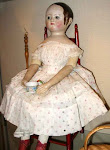
historically produced during the late period of 1830’s until the early part of the 20th century. Among these, the lady- like china stand out as art objects rather than toy dolls.
The highest number of production made in Germany from 1850’s through 1890’s, centered around the cities of Sonnenberg and Nuremberg.

 Ribbon winners chinas
The Hair Dress is a good indication of the period the dolls were manufactured, as they imitated the styles that were fashionable at the time they were made…For example a doll with a chignon, or waterfall hair dress, could be dated as 1860-1870. Bangs would indicate a much later period, early 1890, when this style was worn.
With this in mind, I will attempt on forthcoming posts to show samples and describe types of China Heads according to the decades they were made, in the hopes to achieve an easier, interesting introduction to these dolls while doing justice to this vast industry… and, more importantly, to their fragile beauty.
 Alt, Beck and Gottachalck (ABG) Cafe Au Lait "Spilled Curl" hairstyle ca.1860
 China head dolls wearing the typical hairstyles of the 1860-1890 periods: Curly Top, Civil War and Flat Top
 Civil War type china head ca. 1860
 Conta-Boehm "Waterfall" hairstyle ca. 1865
 "Countess Dagmar" Parian shoulder head
Quite often Chinas were cast on the same molds as Parians, so its not uncommon to find both glazed Chinas and Parians with the same type heads, as an example the so-called
“Countess Dagmar”.
 "Countess Dagmar" china shoulder head using same mold as above
 "Two Sisters" Lego Museum
 Blonde "Low-Brow" style ca. 1880-1890 possibly Hertwig
 The number and variety of face type and hair dress indicate the possibility that a great majority were manufactured in small back yard kilns, a family industry, as toy making had largely been in Germany. Their beauty and detail largely depending on the skill of the individual workman.
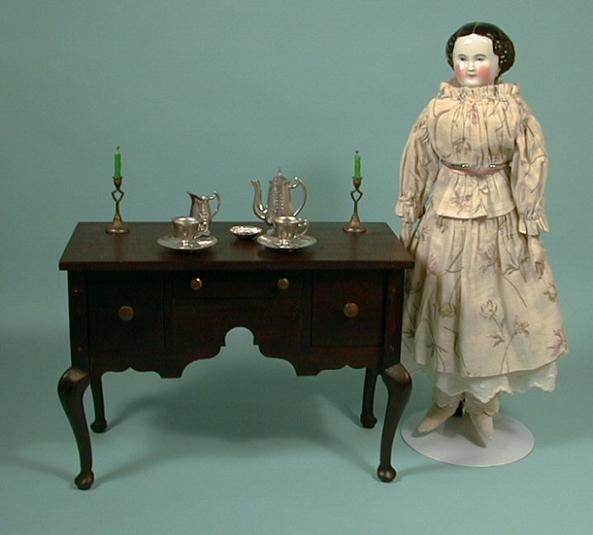
 China head doll ca. 1840; Parian Bisque shoulder head doll ca.1860; French Tea Set ca. 1850
 Two china dolls of very different character, each with inset glass eyes (McDonald Archive, Museum of the City of New York)
 "Frozen Charlottes" of various size, including a tiny Frozen Charlie.
These adorable tiny dolls will be discussed at a later time.
 Beautiful "Civil War" type bride doll ca. 1860
  Queen Victoria by Sir Edwin Landseer ca. 1839
Many china heads, especially those with unusual hair styles, are called "portrait dolls" and are named for those they are supposed to resemble-Queen Victoria, Mary Todd Lincoln, Dolly Madison, Countess Dagmar, Jenny Lind, Adelina Patti, and Alice in Wonderland. It is unlikely that these ever were actual portraits. Doubtless some fancied resemblance has caused collectors to so name them….The dolls from this category will be discussed separately.
 "Queen Victoria" Kister, ca. 1840
  Unfortunately, most china dolls are unmarked that makes it difficult to distinguish which company designed which doll. Sporadically, dolls are marked within its shoulder plates, putting the company name that manufactured the item. Some companies also put a number on the reverse part of the shoulder plate of the china doll.
 Shoulder Head shards probably excavated at sites of destroyed doll factories in Thuringia
Germany ca. late 1800's
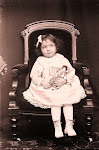
 Similar "Civil War" hairstyle and outfits on china head and on little girl ca. 1860-70
 Grouping of German china dolls, ca. 1840-1860
China heads made after 1898, will of, course be marked GERMANY, Occasionally they will be marked with letters or numbers, but there seems to be no way of finding out what these markings mean.

Harper's Bazaar referred to china dolls as "old fashioned" in 1873, though they continued being made well into the early 20th century. China doll heads were produced in large quantities, in different parts of Europe, counting in the millions.
 "Flat Top" hairstyle on China head wearing beautiful French fashion dress.
 China Shoulder Head dolls ca. 1880


Quite often one can find these charming dolls sitting or standing alone in antique shops and even in flea markets, waiting to be loved and valued again. We need to appreciate these old dolls with particular affection, even if for the thought alone that they have survived well over a hundred years.


