




.jpg)










 Kestner shoulder head with modelled ornament comb, and extravagantly painted blouse with modelled collar, frills and bow. Blue glass eyes and feathery eyebrows, closed mouth with contour and red dividing line ca. 1880
Until today, it was not definite who in Europe the first to manufacture porcelain doll heads was. The Royal Porcelain Manufacture (KPM) Meissen was one of the earliest producers. Initially the first dolls were produced as byproducts and only test models. At that time, Meissen made porcelain dishware and extravagant artistic porcelain.
In eighteen forty, the first porcelain doll heads were produced commercially. Meissen produced head with elegant lady faces which differed from the later little girl doll faces.
 Bisque shoulder head attributed to "Kestner", modelled costume hood, three rowed gold colored necklaceand blouse upper part with bows, characteristic Kestner's one stroke eyebrows, closed mouth with dark red dividing line, ca. 1885
 Bisque shoulder head attributed to "Kestner", modelled bonnet with flower trimming and bow. ca.1885


Often frills and flowers were added to the dolls. Yet they weren’t called proper toy dolls and not suitable for children. They were still ornamental porcelain that pleased the eye. Some small children were given these dolls as presents. The precious doll was kept safe until the child had attained the right age and necessary maturity to appreciate the doll. As a result, many of these dolls remain today.
 The ladies home sewing companion - a parian pincushion doll
 " Dresden Gentleman"

 Alt, Beck and Gottschalk ca. 1870
 ABG "Empress Augusta" a portrait doll.. bisque shoulder head with modelled on jewelry, modelled blouse upper part with blue stripe (also found in pink) modelled black cross
Ca. 1880 Thuringia Germany

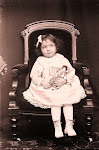
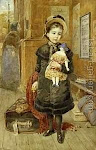
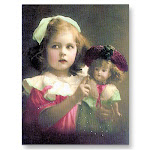
 Child posing with "Limbach" stone bisque doll with modelled bonnet
wax and cloth body with celluloid forearms... ca. early 1900
 "Kestner" China Head with flat top hair style
By 1850 manufactures began to realize that porcelain heads with all of their beauty and strong glossiness seemed unnatural and were thus not perfect. They directed their attention towards an especially fine, white, dull, and transparent type of porcelain: which was called Parian.
 Lowbrow style china shoulder heads, possibly Hertwig..late 1800's
 Alt, Bech and Gottschalck parian "Highland Mary" ca. 1870
 Beautiful and demure Parian child...unknown manufacturer
 The English developed the first parian-ware in the 1840s, and exhibited parian-ware figures at the London International Exhibition in 1851. These figures proved to be very popular, inspiring the Germans to develop their own version of parian porcelain. Soon the many competing German Thuringian companies began making doll heads and limbs in the unglazed white porcelain bisque. They found that they could achieve a higher degree of detail in the modeling than had been possible with the glazed china pieces. Therefore parian dolls can be found with more elaborate hairstyles and in greater variety than the glazed china dolls. There were so many porcelain factories in Thuringia, that it is often very difficult to tell which company made a specific doll. They copied each other's popular models, and employees drifted back and forth between factories.

 Alt, Beck and Gottschalk ca. 1870
 Parian with Dresden decorations..unknown manufacturer. Ca. late 1800's
 "Simon and Halbig" Parian Lady ca, 1860
 Parian nurse maid and child; doll house dolls ca. 1880
 " Little mothers playing house"
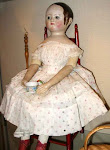
 Beautiful "Kling" shoulder head made from bisque porcelain; blue paperweight glass eyes, leather body with bisque forearms ca. 1880

 "The Dresden Gentleman" Dornheim, Koch and Fischer...parian shouder head, hair
styled modelled as a young cavalier...ca. 1865
Young lady made of bisque porcelain C.F. Kling...Thuringia, Germany, ca. 1880
The period of the exquisite Parian dolls was quite short because they were still not suitable for child’s play. In addition, their white marble skin color was unnatural so the porcelain was painted flesh-like tone and then was not called Parian but bisque.
Many Parian dolls are around today because owners knew of their fragility and kept them safe. Children could only play with them as they matured. That is a good thing. I believe these dolls were some of the most beautiful dolls produced.
Many Parian dolls are around today because owners knew of their fragility and kept them safe. Children could only play with them as they matured. That is a good thing. I believe these dolls were some of the most beautiful dolls produced.


