
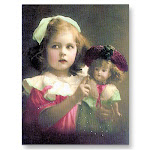
What is a Doll?

How long have we had this love affair with Dolls?

Pearls of Wisdom:

New World Dictionary describes a doll as - "a child's toy, puppet, marionette, etc. made to resemble a human being."


Monday, March 8, 2010

"Marie Antoinette," The Last Queen of France

They held lavish parties and enjoyed gambling, rumors were already circulating about the queen's outrageous spending...."The Queen of Deficit"


Princess De Lamballe, Marie Antoinette and Comtesse De Noailles


The young couple’s fears were well-founded. They were, indeed, “too young to reign.” And Marie Antoinette, ignoring formalities of the Versailles court and adapting procedures she’d known in Vienna, began to sow the seeds of her undoing.

French Court Mannequins and Couture

During the 17th and18th century Paris directed the direction of fashion, Germany and Holland produced and supplied the wooden dolls, Paris devoted itself to dressing them.
These dolls travelled all through war ravaged Europe in jeweled trunks, promoting newest French fashions to eagerly waiting nobility ladies, who would then have their dressmakers recreate the sumptuous gowns.

The Milliner


Rare and exquisite 18th century Wax Doll


The emphasis of the fashion doll of the 18th century, was always on the couture. Marie Antoinette had an entire set of dolls presented to her as a means for selecting her wedding trousseau, she was placated with dolls in the extravagant frenzies that were to cost her her head.


"Mary Jenkins" English Wooden


It is interesting to note that the china, and composition dolls that we think of today as “antique” dolls did not come into production until the early 19th century, so Marie Antoinette would have probably never known anything but wooden dolls. Although some wax figures were making their transition from religious figures into play dolls, still they were not as common as the wooden ones and decidedly more expensive.


Mannequin Dolls second half of 18th century


Restored 18th century doll

Europe, through the revolutionary 18th century gave to the world along with culture and history, a clearly defined image of the doll. After the French Revolution dolls that were only enjoyed by the aristocracy began to be enjoyed by children of the poor. Slowly with the growth of the middle class, dolls moved into mass production and gradually became industrialized in tune with the demands of the “Modern Age”.

The Beginning of the End

After seven years of marriage, the queen became pregnant with their first child. She had four children and only one reached adulthood, Marie Therese, who was just eleven when the Revolution erupted.
Two mercifully died of tuberculosis and were spared the horrors of the Revolution, but the ten year old dauphin was cruelly tortured by revolutionaries.


Louis’ decision to help the American colonies in their war of independence had made matters worse. France’s involvement was costly - both for the purse and for the king.
It was no coincidence that two years after the new American republic created a constitution, the French people revolted against their own monarchy. French help with the war meant that long suffering Frenchmen, returned with ideas they could apply in their own country. If the British king could be deposed in America, might the French king be deposed in France?

Liberte, Egalite, Fraternite


After the revolution began, the king never doubted he would be killed. When France celebrated the third anniversary of the Bastille’s fall, Louis quoted ..."they will not assassinate me; they will put me to death another way." On the 11th of December, 1792 - Louis was tried and sentenced to death by guillotine.
In ten months, Marie Antoinette would meet a similar fate.


Marie Antoinette wore a white gown, a white handkerchief covered her shoulders and a white cap her hair; a black ribbon bound this cap round her temples ... On reaching the scaffold she inadvertently trod on the executioner’s foot. “Pardon me,” she said, courteously. She knelt for an instant and uttered a half- audible prayer; then rising and glancing towards the towers of the Temple, “Adieu, once again, my children,” she said; “I go to rejoin your father"


Liberty, Equality and Fraternity!

Tuesday, March 2, 2010

Queen Elizabeth I "The Golden Age"

The Elizabethan era was a time associated with the reign of Queen Elizabeth I and it was considered the height of the English Renaissance, a golden age.


These were the times of the flowering of English poetry, music, literature, and theater. William Shakespeare, and many others composed plays that broke free of England's past style of plays.


"Tess" Creation by Kathy Patterson


The Victorian Era and the early twentieth century idealized the Elizabethan era. "The long reign of Elizabeth I was England's Golden Age...'Merry England,' in love with life, expressed itself in music and literature.


Museu De Cluny Medieval exhibit


Elizabeth's determination not to "look into the hearts" of her subjects, to moderate the religious persecutions of previous Tudor reigns—the persecution of Catholics under Henry VIII, and of Protestants under Mary Queen of Scots—appears to have had a moderating effect on English society in general. While Elizabethan England has been characterized by skeptics as a "brutal dictatorship," it was, as brutal dictatorships go, one of the more benign.

Elizabethan Children

John White painting of native girl holding doll. Roanoke Va. 1585


Children were subservient to the adults in the family. They were raised to respect and obey their parents. It was necessary for boys to attend grammar school, but girls were not allowed in any place of education. Only the wealthiest people allowed their daughters to be taught at the home. Infant mortality was high during the Elizabethan era, so the children were cherished and loved by all members of the household. They were given many toys to play with - dolls, toy soldiers, hobby horses and the like.

17th and 18th Century Dolls

With the flowering of the Arts in Central Europe during the Renaissance, numerous paintings showing dolls provided some documentation on their development.
We know that primarily they were made of wood or wax, and that some heads were manufactured from glazed stoneware.


Victoria and Albert Museum


" Olive and Mildred " creations of artist Kathy Patterson


Dolls wearing the latest fashions were sent to the Queen of England, to show what was in vogue with the ladies in the court of France. Perfection even to the underclothes was expected, so that a fashionable silhouette could be achieved.


Infanta "Isabella Clara Eugenia" of Spain holding a doll made to the likeness of Queen Elizabeth the I..... from Elizabeth the Golden Age.
These dolls were allowed to pass between rival countries even during times of war.